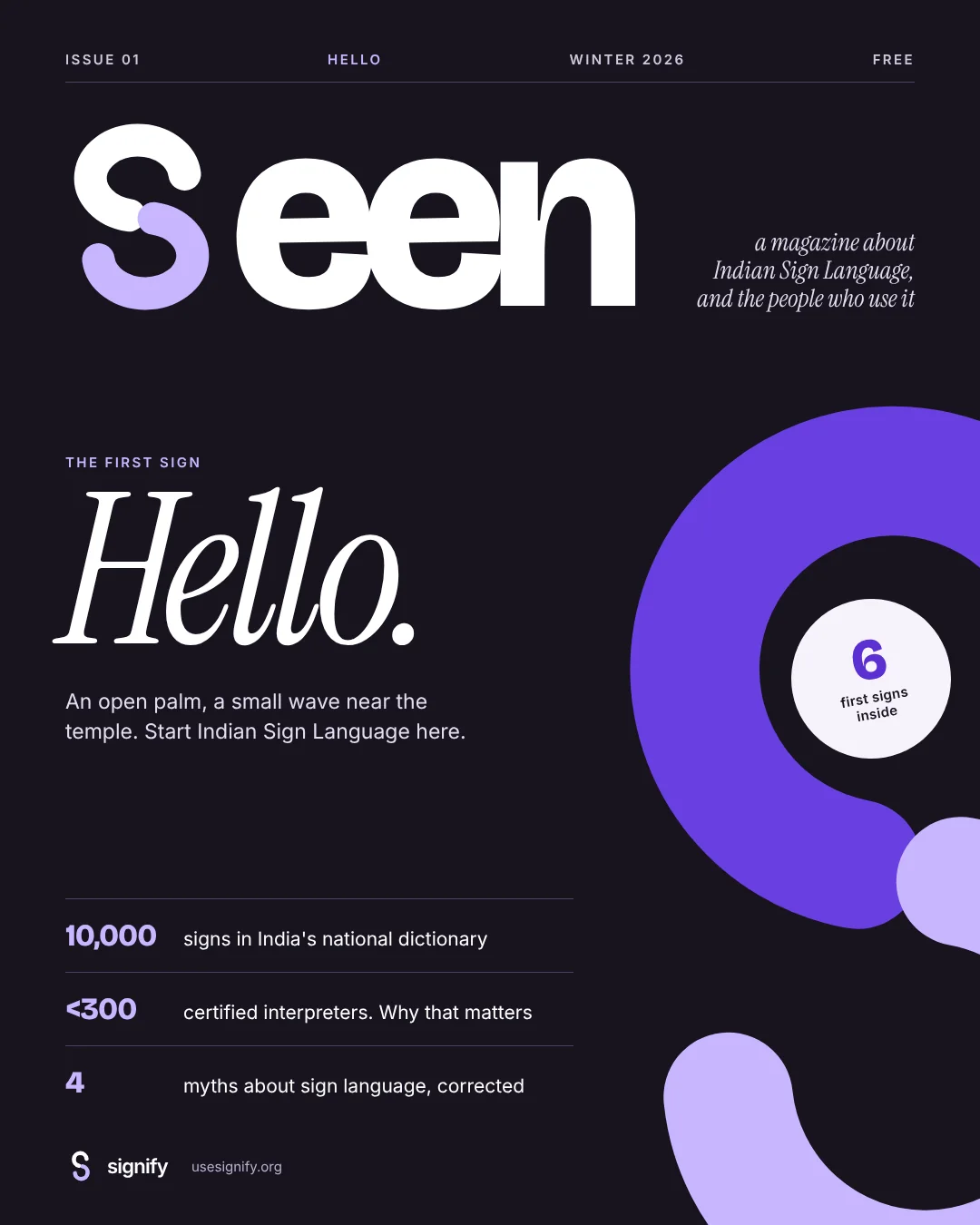
Seen · Issue 01 · Winter 2026
Hello.
What Indian Sign Language is, how it got its national dictionary, four myths, and six first signs to learn today.
Flip through the issue
Open full screenFlipbook hosted on Heyzine. Prefer scrolling? Every page is below, and the full text follows.
Read it as text
The full issue, for screen readers and quick reading.
From the editor
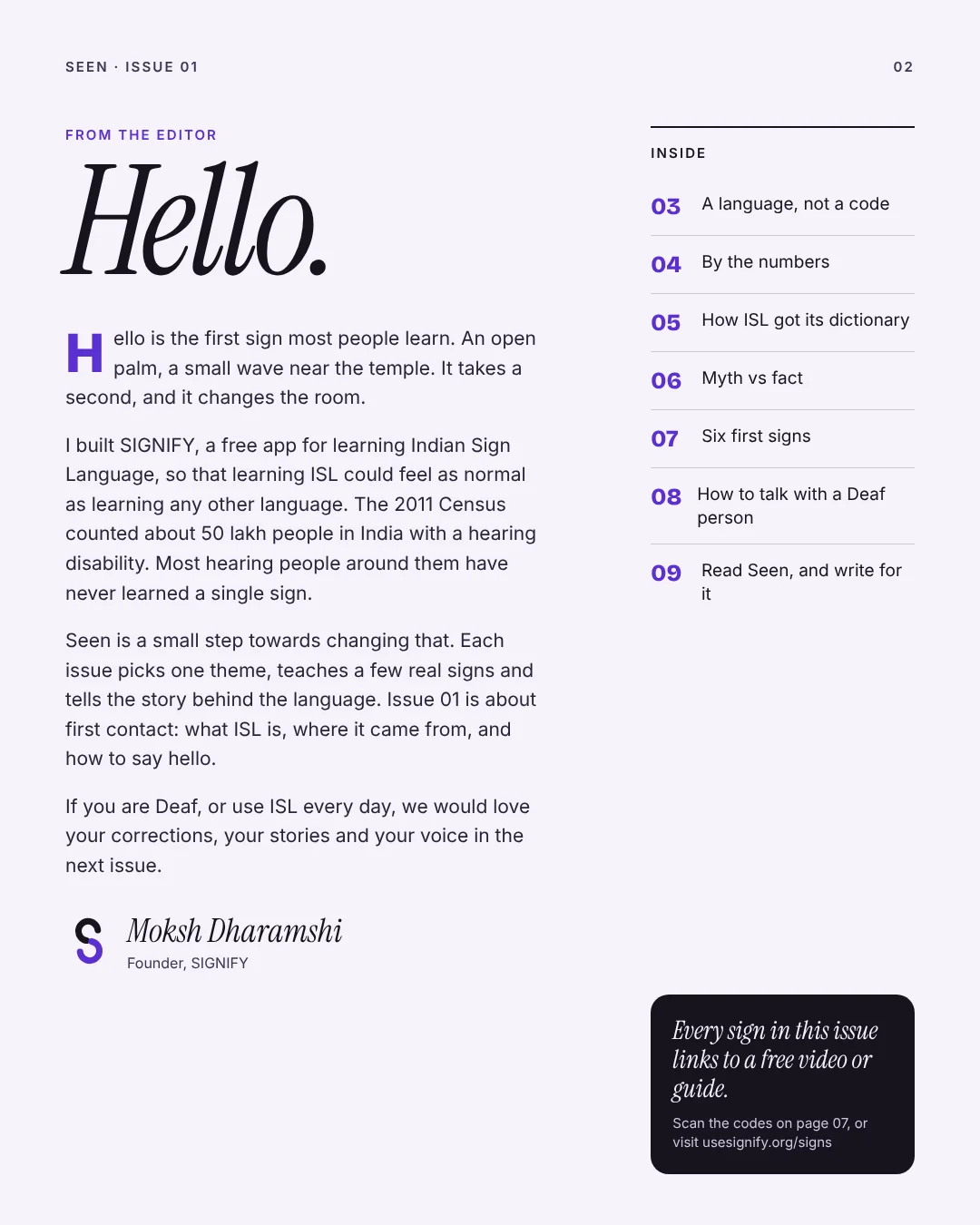
Hello is the first sign most people learn. An open palm, a small wave near the temple. It takes a second, and it changes the room.
I built SIGNIFY, a free app for learning Indian Sign Language, so that learning ISL could feel as normal as learning any other language. The 2011 Census counted about 50 lakh people in India with a hearing disability. Most hearing people around them have never learned a single sign.
Seen is a small step towards changing that. Each issue picks one theme, teaches a few real signs and tells the story behind the language. Issue 01 is about first contact: what ISL is, where it came from, and how to say hello.
Moksh Dharamshi, founder of SIGNIFY
A language, not a code
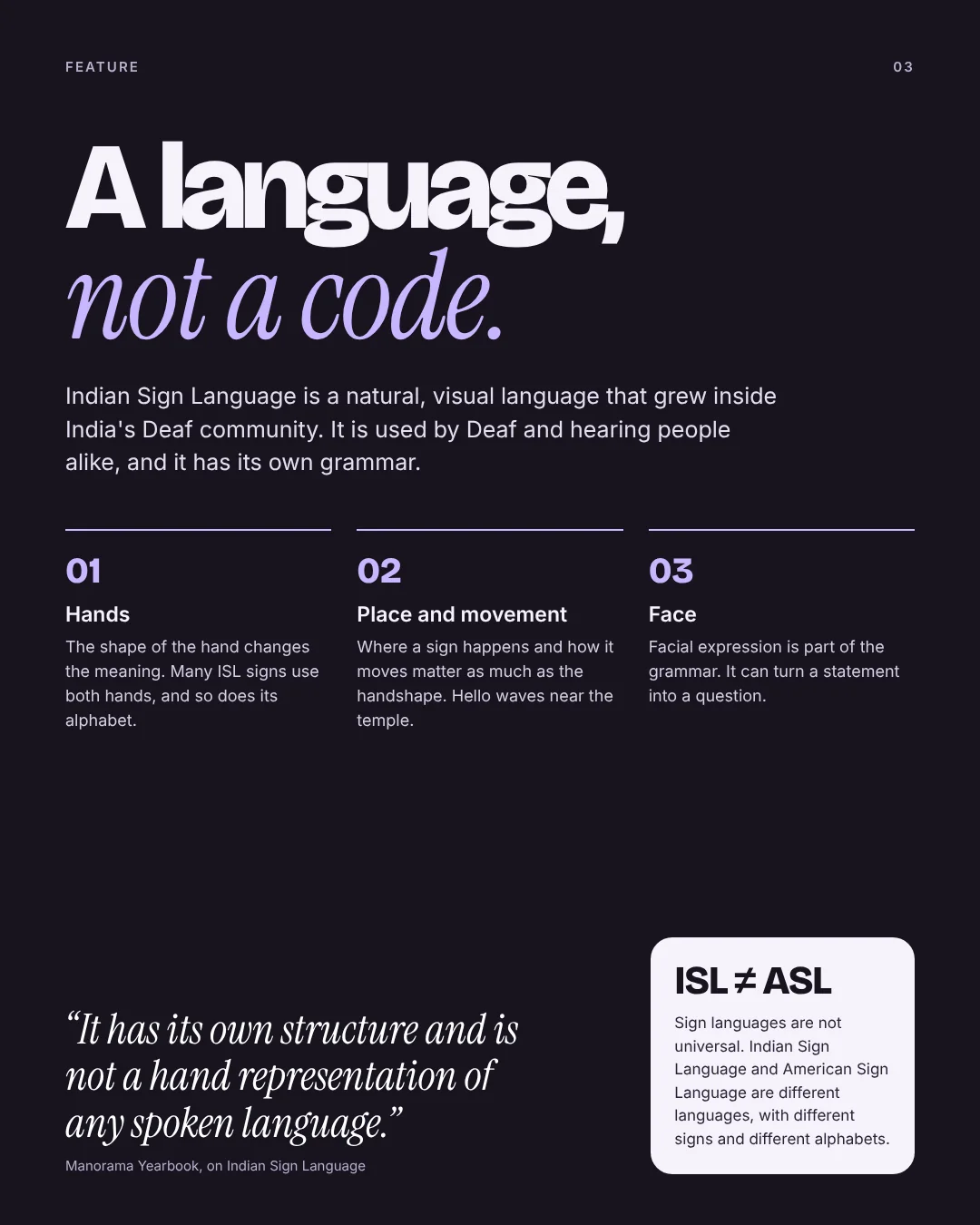
Indian Sign Language is a natural, visual language that grew inside India's Deaf community. It is used by Deaf and hearing people alike, and it has its own grammar. It is not Hindi, or English, on the hands.
Sign languages are not universal. Indian Sign Language and American Sign Language are different languages, with different signs and different alphabets.
- Hands: the shape of the hand changes the meaning. Many ISL signs use both hands, and so does its alphabet.
- Place and movement: where a sign happens and how it moves matter as much as the handshape.
- Face: facial expression is part of the grammar. It can turn a statement into a question.
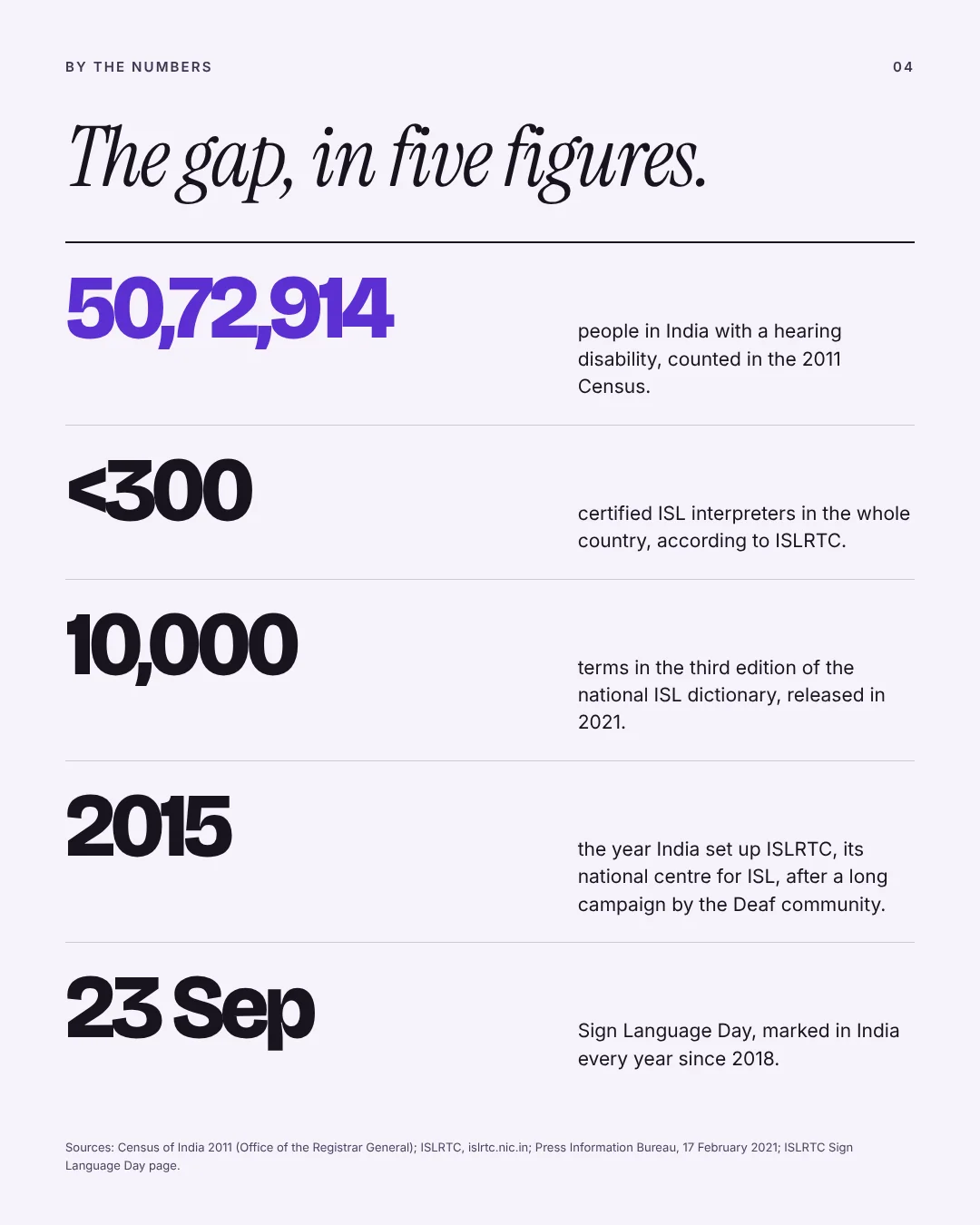
The gap, in five figures
- 50,72,914 people in India with a hearing disability, counted in the 2011 Census.
- Fewer than 300 certified ISL interpreters in the country, according to ISLRTC.
- 10,000 terms in the third edition of the national ISL dictionary, released in 2021.
- 2015: the year India set up ISLRTC, its national centre for ISL, after a long campaign by the Deaf community.
- 23 September: Sign Language Day, marked in India every year since 2018.
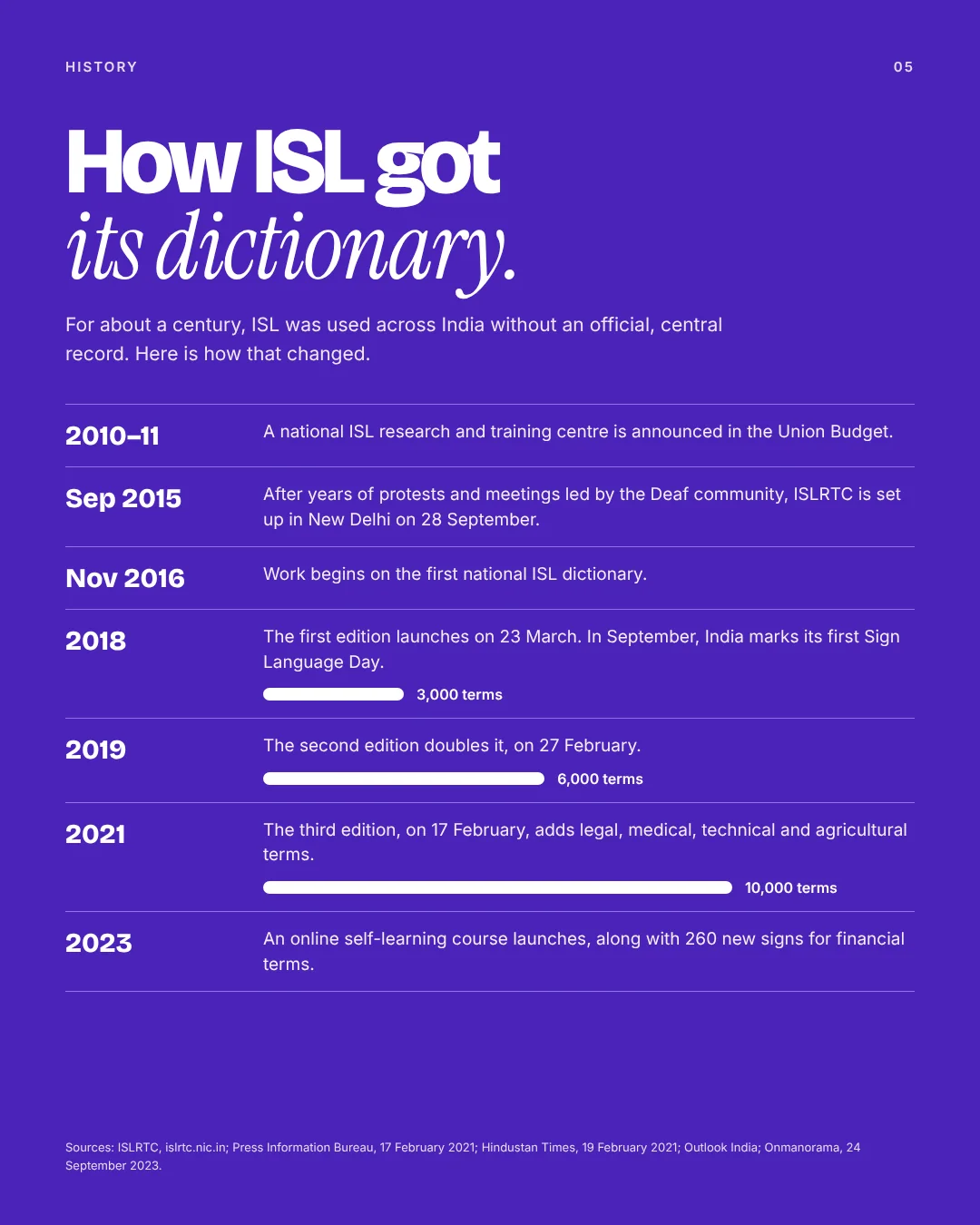
How ISL got its dictionary
- 2010–11: a national ISL research and training centre is announced in the Union Budget.
- September 2015: after years of protests and meetings led by the Deaf community, ISLRTC is set up in New Delhi.
- November 2016: work begins on the first national ISL dictionary.
- 2018: the first edition launches with 3,000 terms, and India marks its first Sign Language Day.
- 2019: the second edition doubles it to 6,000 terms.
- 2021: the third edition reaches 10,000 terms, adding legal, medical, technical and agricultural vocabulary.
- 2023: an online self-learning course launches, with 260 new signs for financial terms.
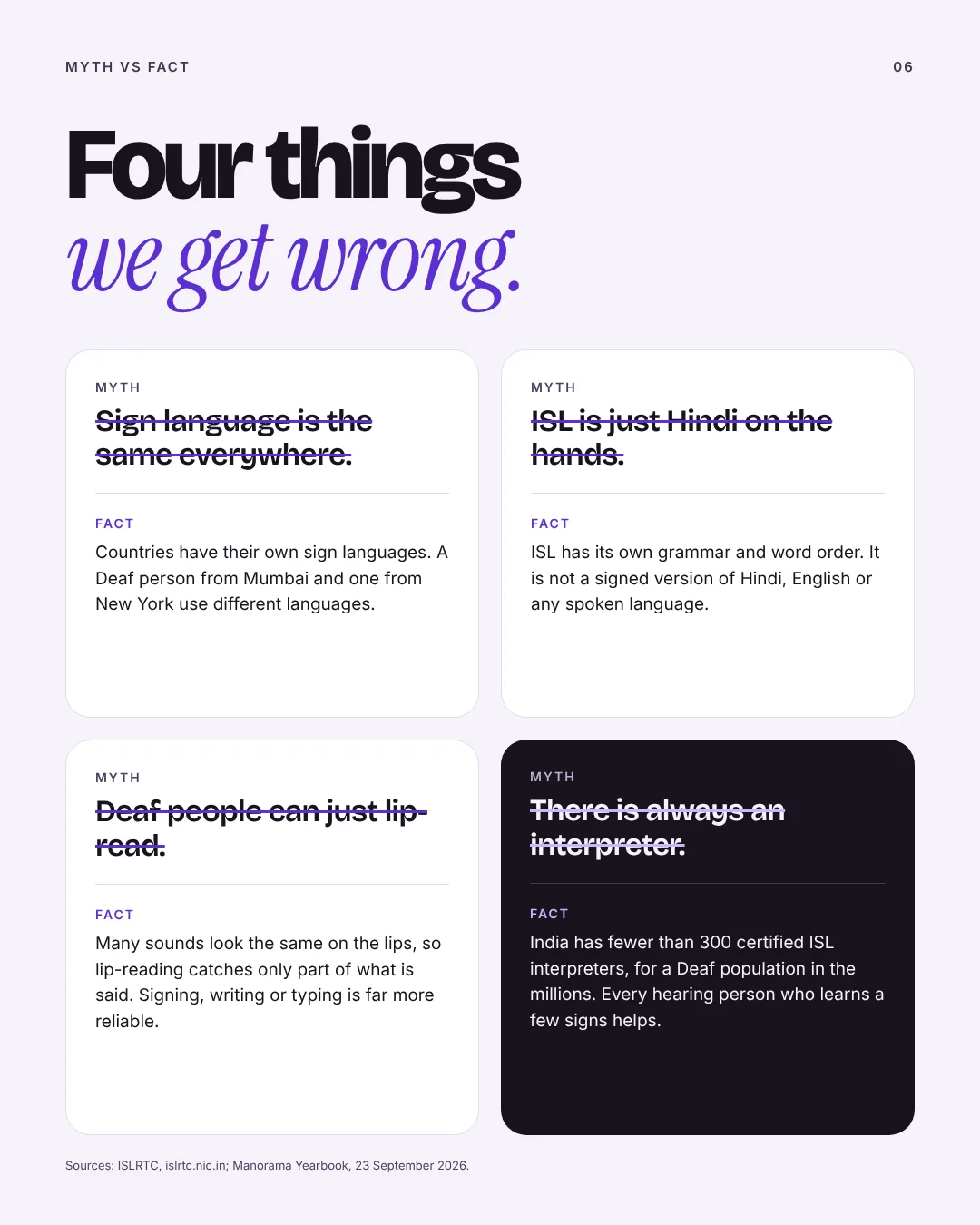
Four things we get wrong
- "Sign language is the same everywhere." It isn't. A Deaf person from Mumbai and one from New York use different languages.
- "ISL is just Hindi on the hands." ISL has its own grammar and word order.
- "Deaf people can just lip-read." Many sounds look the same on the lips, so lip-reading catches only part of what is said.
- "There is always an interpreter." India has fewer than 300 certified ISL interpreters. Every hearing person who learns a few signs helps.
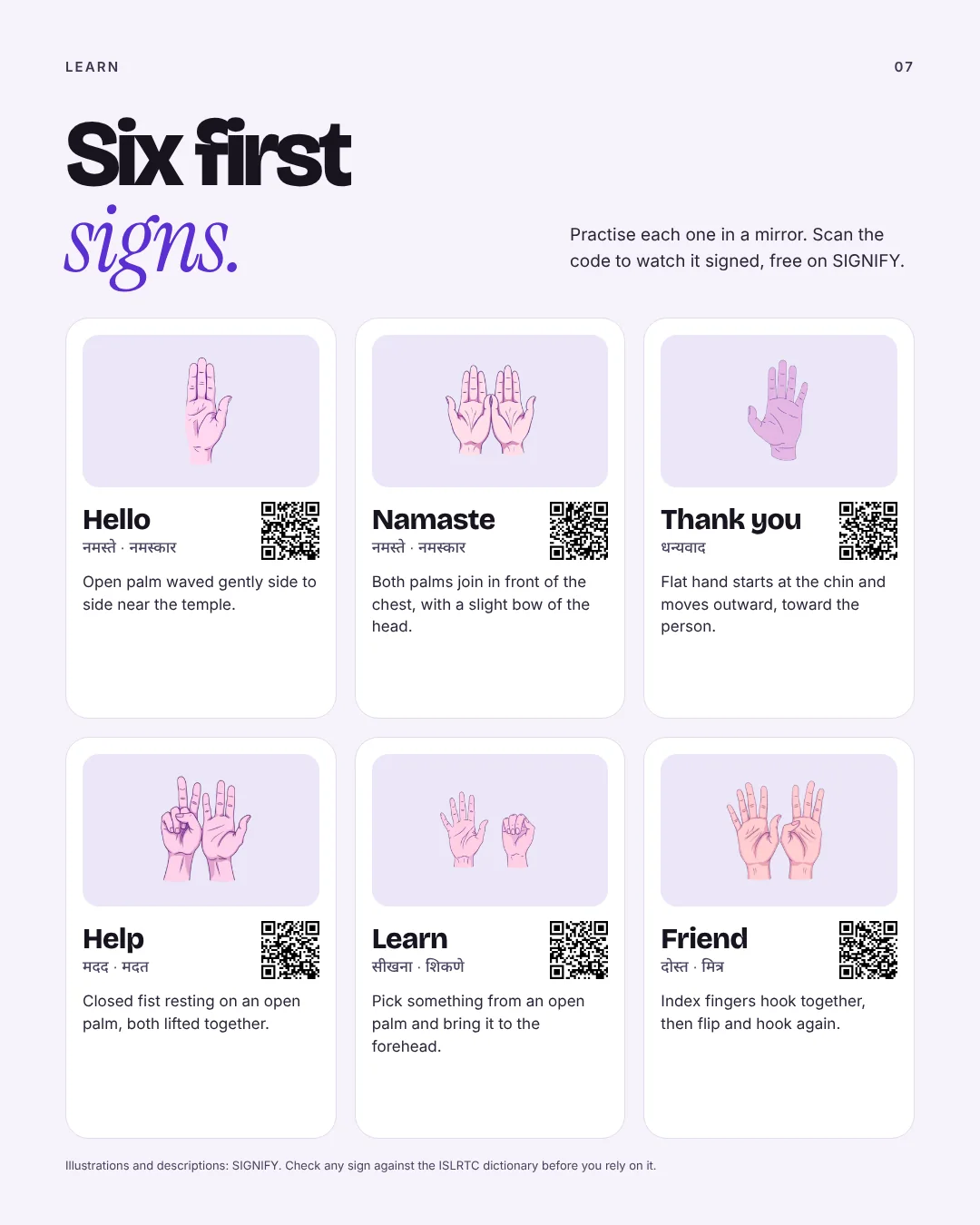
Six first signs
- Hello (नमस्ते): open palm waved gently side to side near the temple.
- Namaste (नमस्ते): both palms join in front of the chest, with a slight bow of the head.
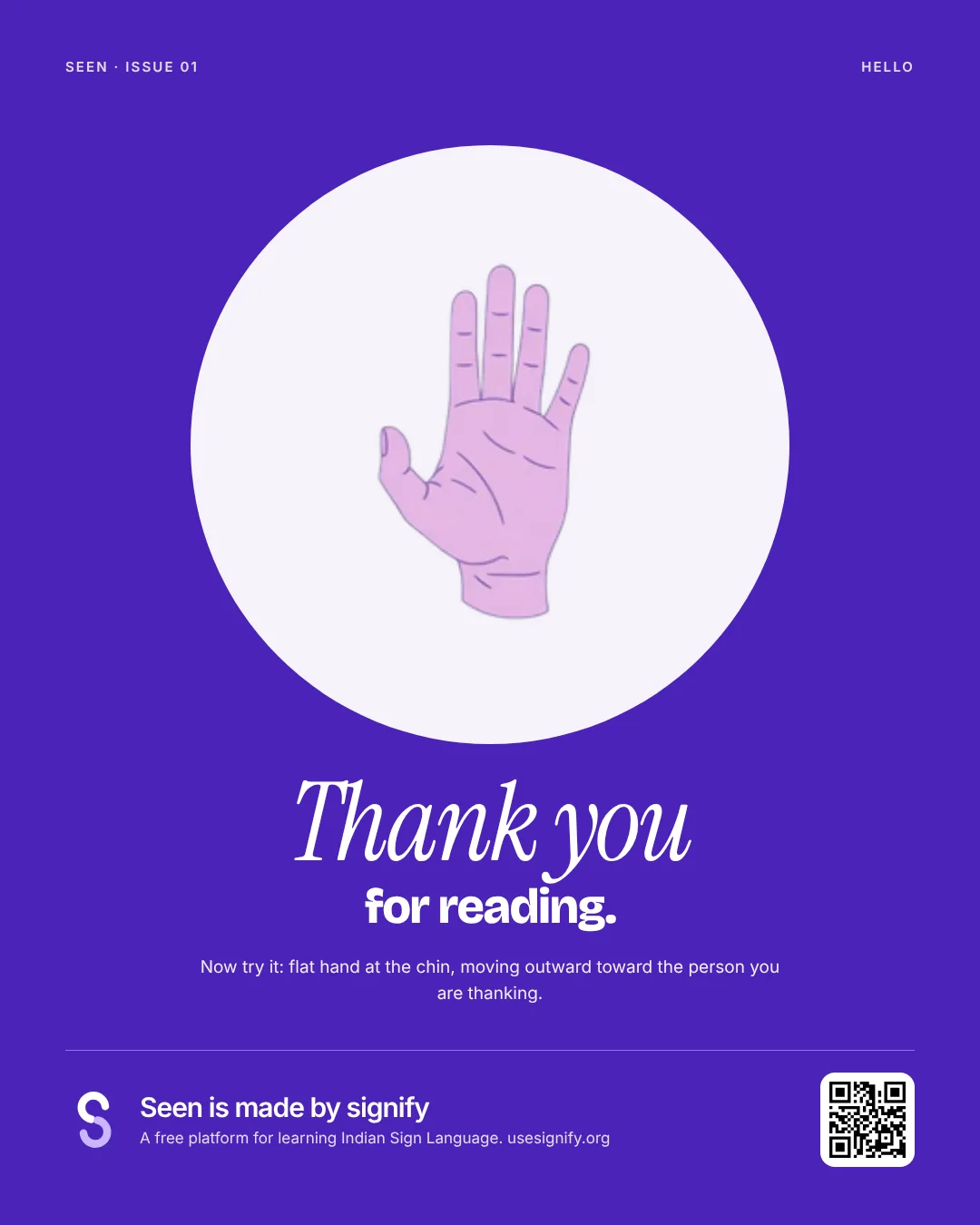
- Thank you (धन्यवाद): flat hand starts at the chin and moves outward, toward the person.
- Help (मदद): closed fist resting on an open palm, both lifted together.
- Learn (सीखना): pick something from an open palm and bring it to the forehead.
- Friend (दोस्त): index fingers hook together, then flip and hook again.
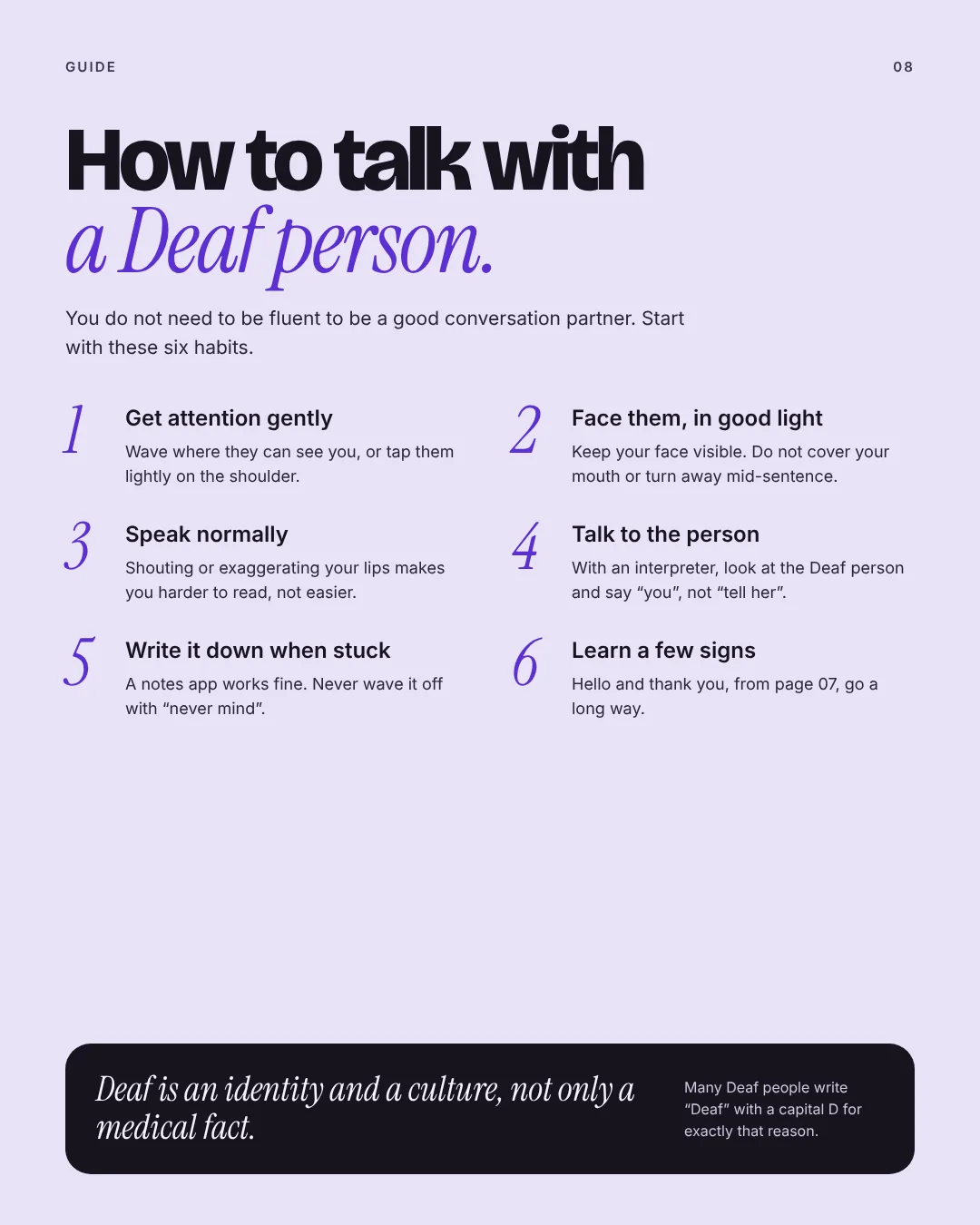
How to talk with a Deaf person
- Get attention gently: wave where they can see you, or tap them lightly on the shoulder.
- Face them, in good light, and keep your face visible.
- Speak normally. Shouting or exaggerating your lips makes you harder to read.
- Talk to the person. With an interpreter, look at the Deaf person and say "you", not "tell her".
- Write it down when stuck. Never wave it off with "never mind".
- Learn a few signs. Hello and thank you go a long way.
Write for Seen
Are you Deaf, an interpreter, or a family member of someone who is? We want your stories, corrections and ideas. Seen should be written with the Deaf community, not just about it. Write to usesignify@gmail.com or message @signifyisl on Instagram.
Next issue: At the doctor. The signs for pain, medicine and help, and what a hospital visit is like without an interpreter.
Sources: Census of India 2011 (Office of the Registrar General); ISLRTC, islrtc.nic.in; Press Information Bureau, 17 February 2021; Hindustan Times, 19 February 2021; Onmanorama, 24 September 2023; Manorama Yearbook, 23 September 2026.